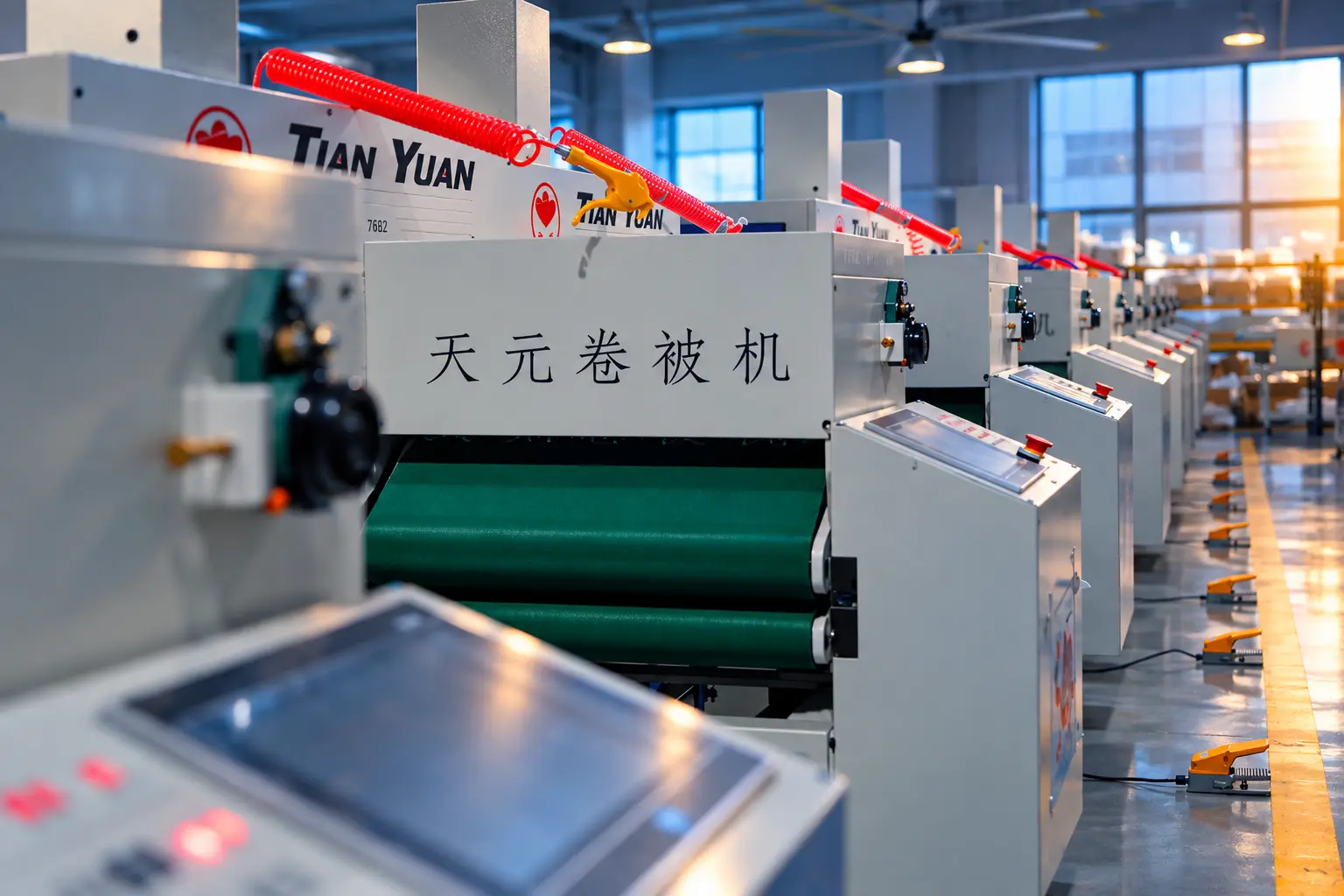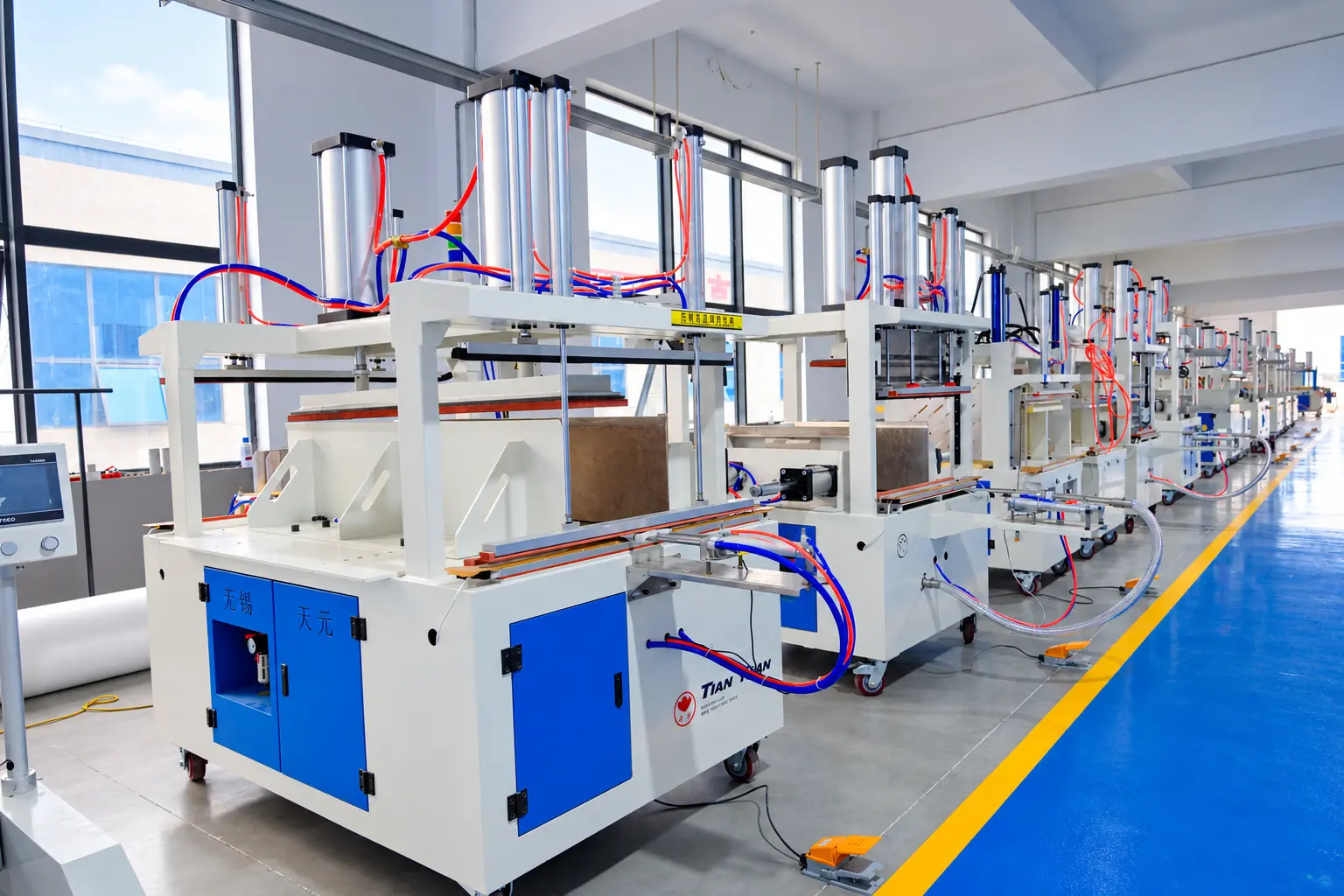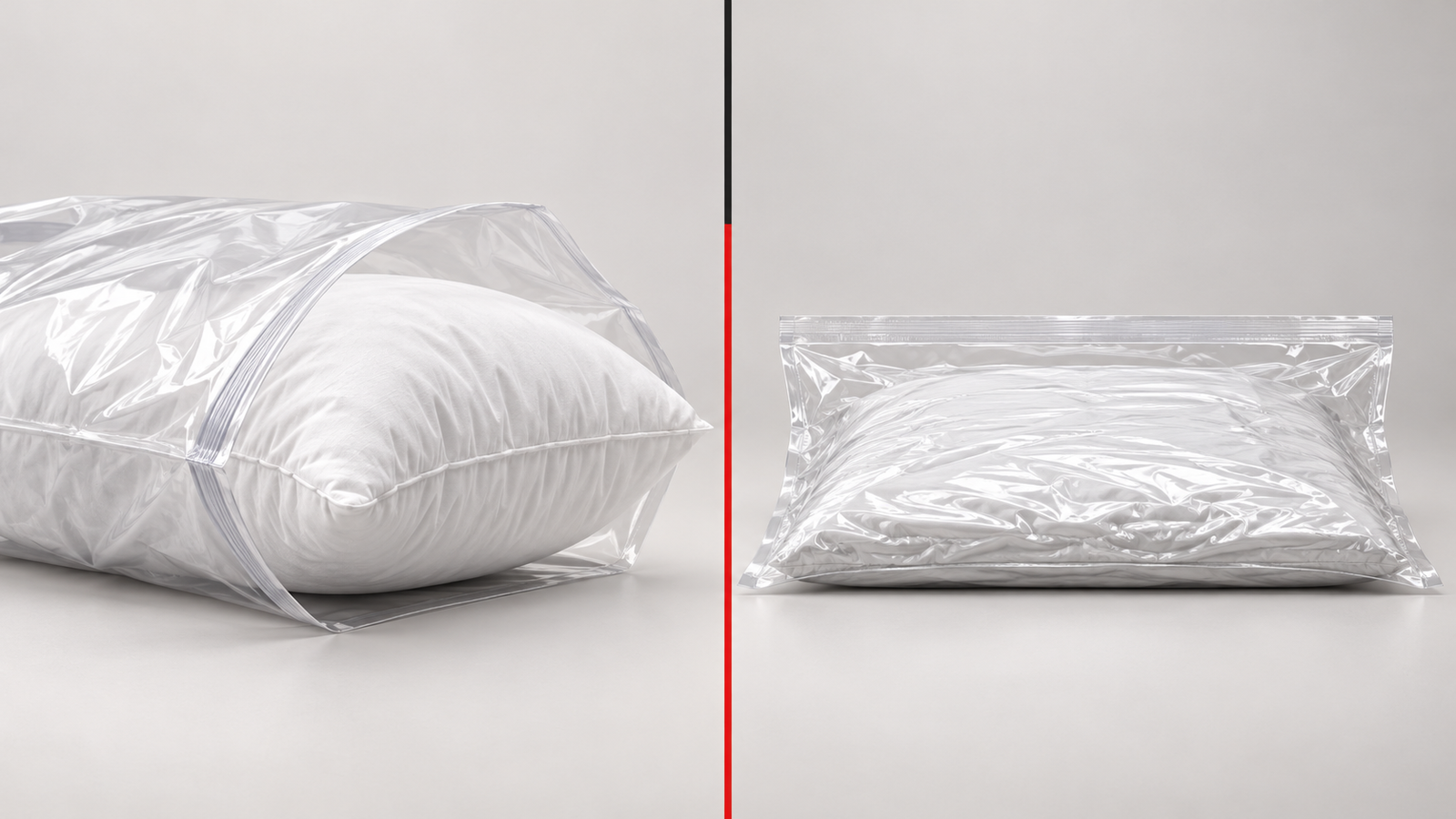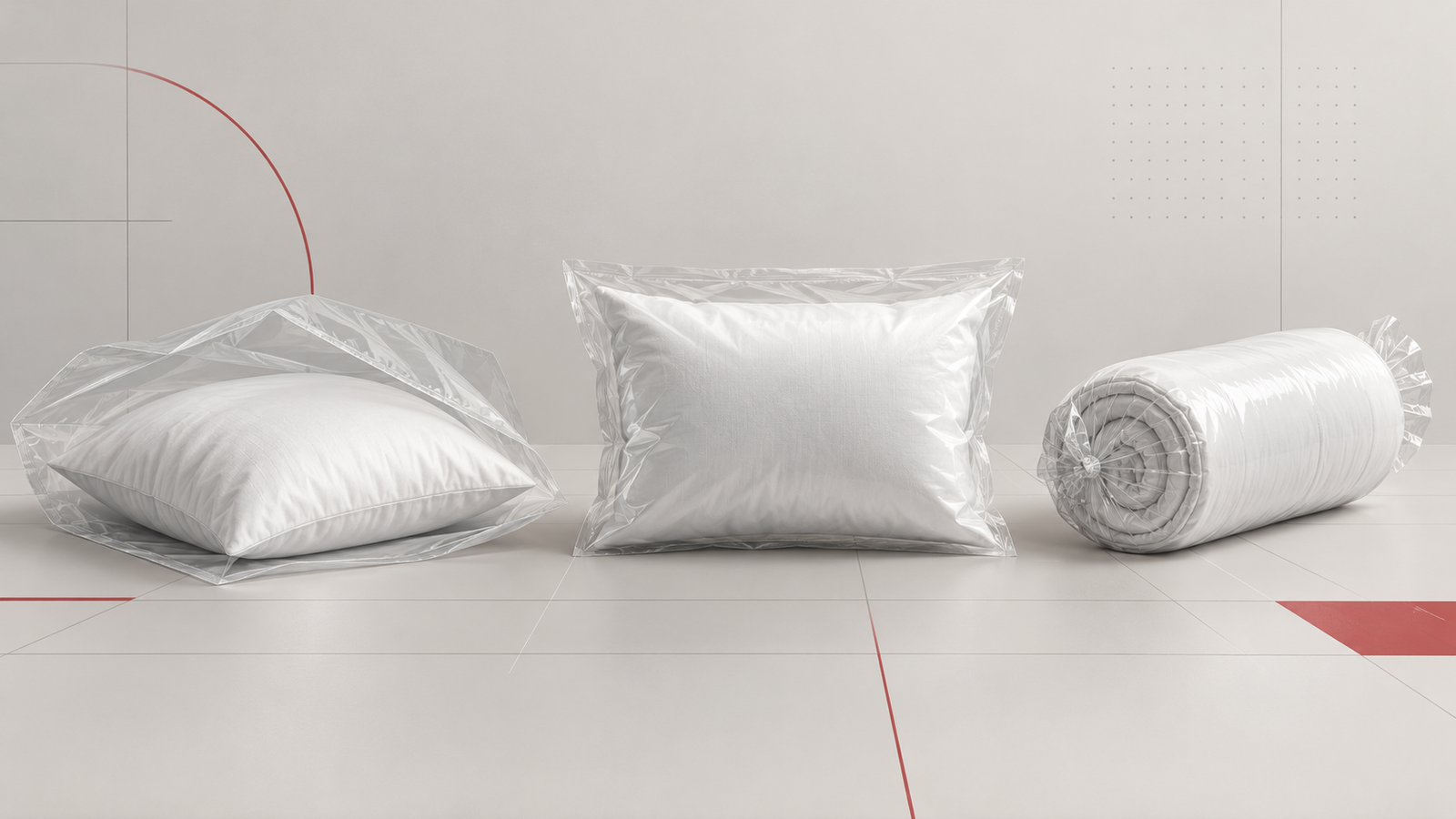
A search for a pillow packing machine can lead to very different equipment. One machine compresses a pillow so an operator can place it in a bag. Another removes air and seals the package. A rolling machine produces a cylindrical pack. Those processes solve different packaging problems, so the right starting point is the package your customer needs—not a machine model.
This guide helps bedding manufacturers prepare an equipment brief and compare the available process routes. Test the actual pillow, film and finished package before committing to a line configuration.
First, define the finished pillow package
Write down the pillow’s uncompressed dimensions, fill material, cover construction and normal variation between batches. Then define the finished pack: flat or rolled, bag material, target dimensions, seal requirements and any label or outer-carton constraints. A package that looks compact immediately after processing may recover differently after storage, so judge the result after a sample test under your own conditions.
Is the main difficulty inserting a bulky item into a bag? Does the bag need to be vacuum sealed? Is a roll-shaped retail or shipping pack required? These questions separate three common routes.
Three pillow packaging routes
1. Compression followed by bagging
A compression bagging machine presses a bulky pillow to make bag insertion easier. Tian Yuan describes its HFD-3000 Compress Bagging Machine and BZZDJ-1 Compress Bagging Machine as equipment for fluffy products including pillows, cushions and quilts. Their product pages describe longitudinal compression before bagging.
This route is worth examining when the bottleneck is handling a bulky pillow at the bagging station. Do not assume that the press also performs vacuum extraction, sealing or every bag-handling step; confirm the complete sequence for the quoted model and line.
2. Compression with vacuum sealing
Where the required finished pack includes an evacuated and sealed bag, evaluate a vacuum sealing process. Tian Yuan lists the HFD-880-C Vacuum Sealing Machine for fluffy home-textile products, including pillows. Its product page describes compression, vacuum extraction and heat sealing.
Discuss film compatibility, seal position, finished dimensions and how you will test seal integrity. Choose a vacuum process because the package specification calls for it, not simply because “vacuum” sounds more advanced.
3. Pillow rolling
If the buyer needs a cylindrical package, consider a pillow rolling machine. Tian Yuan’s JZJ-2 and JZJ-3 are listed for pillow rolling. The JZJ-2 page describes a vacuum-compression, sealing and rolling sequence; the JZJ-3 page identifies latex, memory-foam and sponge pillows among its applications.
These model descriptions are starting points, not proof that every pillow will produce the same roll. Test the fill material, pillow size and packaging material together, then measure the roll after it has had time to recover.
What to compare before requesting a quotation
| Buying question | Why it matters |
|---|---|
| What pillow sizes and fill materials will run? | Different sizes or fills may need different settings, tooling or process trials. |
| What is the required final shape? | Flat bagging, sealed compression and rolling lead to different machine routes. |
| Which bag or film will be used? | The material and seal specification affect the packaging method and trial result. |
| Which steps are manual and which are automated? | “Pillow packing machine” does not describe the full line scope. |
| What is the realistic product mix per shift? | One reference sample may not represent the production schedule. |
| What floor space and utilities are available? | The machine must fit the site and its electrical and compressed-air supply. |
| How will the sample be judged? | Agree on package dimensions, appearance, seal quality where relevant and recovery after storage. |
Ask the supplier to identify the machine’s boundaries on a process drawing: product loading, compression, bag presentation, vacuum or sealing if required, rolling if required, discharge and inspection. This makes quotations easier to compare and exposes additional equipment or operator tasks.
A practical sample-test plan
Send representative pillows, not only the easiest model. Include the smallest and largest sizes, different fill types, and any product with an unusual cover or shape. Provide the proposed bag or film, target package dimensions and a photo of an acceptable finished pack if available.
During the trial, record the settings used for each sample. Inspect the package immediately, then again after a defined storage period. Check final shape, surface appearance, seal where applicable, and whether the pillow recovers to an acceptable condition after opening. If the line handles several pillow families, test changeovers rather than relying on a single demonstration.
Avoid two common specification mistakes
Buying by the broad keyword alone. “Pillow packing machine” includes more than one process. A quotation for compression bagging cannot be compared fairly with one for vacuum sealing or rolling until the requested package is the same.
Treating a product-page capacity as guaranteed line output. Published machine figures describe a model under stated conditions. Actual output depends on the pillow, packaging material, operators, upstream supply, downstream handling and inspection requirements. Ask for a trial using your production mix before setting a line target.
Frequently asked questions
Is a pillow compression machine the same as a pillow rolling machine?
No. Compression changes the pillow’s size or shape for the next packaging step. Rolling forms a cylindrical package. Some machines combine steps, so confirm the exact sequence for the selected model.
Do all pillow packing machines vacuum seal the bag?
No. Compression bagging, vacuum sealing and rolling are distinct process routes. Specify the finished package first, then verify which steps the equipment performs.
What should I send when asking for a machine recommendation?
Provide pillow dimensions, fill and cover materials, expected product mix, bag or film details, desired pack shape and dimensions, site utilities and a floor plan. Physical samples are the best basis for checking the result.
For a closer process comparison, see compression bagging versus vacuum sealing for bedding. Use the pillow packaging sample-test checklist to agree on pass/fail criteria before requesting a final quotation.
Discuss your pillow packaging brief
If your factory is comparing flat bagging, vacuum sealing or roll packing, send Tian Yuan your pillow samples and target package details. Review the compression packing range and roll packing range, then request a project discussion with your product and line requirements.